Choosing a Line Array Audio System is not simply a matter of selecting the largest cabinet or the highest wattage. The right system must match the venue, audience size, program material, and installation conditions. A compact theater may need controlled coverage, while an outdoor festival demands greater throw, headroom, and weather awareness. Small details matter. Balcony seats reveal weak decisions.
Bob McCarthy, a respected sound-system designer and author, reminds designers, “A line array is not a line source.” His observation challenges a common assumption. Array performance depends on cabinet spacing, splay angles, frequency, processing, and the room itself. More boxes do not automatically create better coverage. A poorly configured system can produce excessive bass near the stage and weak vocals at the rear.
This guide explains how to evaluate a Line Array Audio System through practical, measurable criteria. It considers vertical dispersion, horizontal coverage, maximum sound pressure level, intelligibility, rigging, amplifier compatibility, and DSP control. It also examines listening distance and audience geometry, because specifications rarely describe the whole experience. A loudspeaker may look impressive on paper yet struggle in a reflective hall.
Real-world testing remains essential. Walk the room. Listen from the last row. Check speech clarity beside the subwoofers. Review prediction software, then compare it with measurement data. Some choices will still involve compromise. Budget limits, transport weight, and setup time can change the best technical answer. That is not failure. It is part of responsible system design.
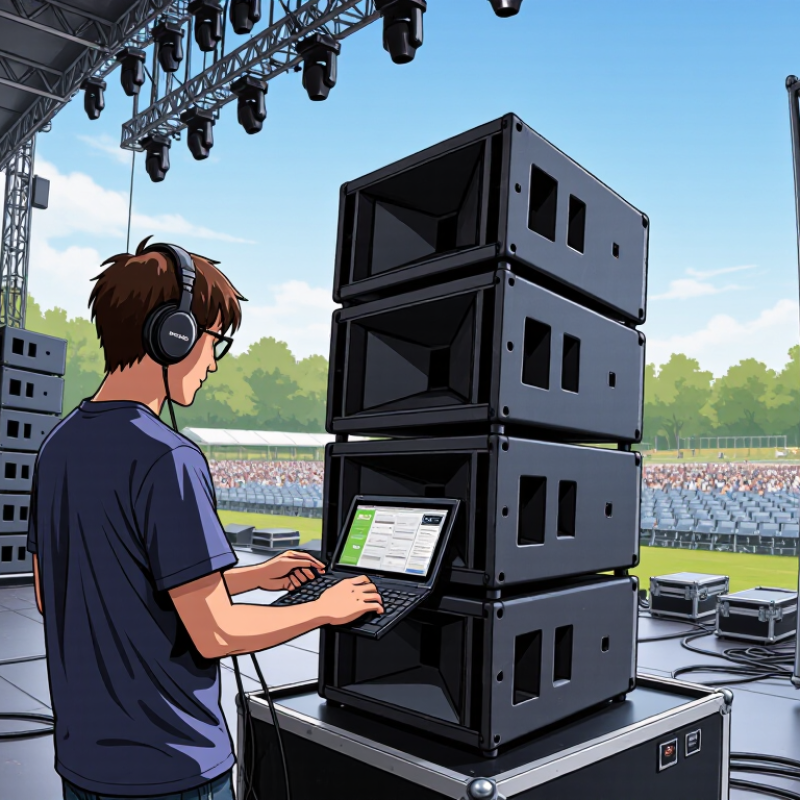
Choosing a line array system starts with the venue, not the loudspeaker count. Measure room length, ceiling height, stage width, and reflective surfaces. A narrow hall may need controlled horizontal dispersion, while a wide outdoor audience needs wider coverage. Note balconies, side seating, and blocked sightlines. Audience size matters, but density matters more. Five hundred people close together can demand more output than seven hundred spread across a field. Estimate listening distance and required sound pressure levels with a qualified system designer. Use technical data, prediction software, and on-site measurements when possible.
Tips: Mark the farthest seat before selecting array elements. Check coverage at ear height. Allow headroom for speech peaks and musical transients. Avoid choosing by wattage alone. Sensitivity, impedance, amplifier limits, and rigging requirements also matter. For speech, prioritize vocal clarity around the audience perimeter. For music, inspect low-frequency consistency between front and rear rows. A delay system may solve a long-room problem better than adding excessive main-array elements. Keep emergency access and safe load limits in the plan.
A practical test is revealing. Walk the room during rehearsal and listen from corners, under balconies, and near the mix position. If one area sounds harsh while another feels distant, the design needs adjustment. Sometimes the first prediction is wrong. Weather, curtains, empty seats, and stage volume can change the result. Document these observations, then retune angles, delays, or levels before the audience arrives. Good coverage feels even, not merely loud.
Choosing a line array system starts with the venue, not the loudspeaker cabinet. Room shape matters. Measure audience depth, ceiling height, stage width, and reflective surfaces before comparing specifications. A straight configuration can project evenly across distant seats. A J-shaped array usually directs more energy toward nearby listeners. Curved configurations may provide smoother vertical coverage in compact venues.
Compare each system’s maximum SPL, frequency response, dispersion, sensitivity, and power handling. These figures describe performance, but they need context. A high SPL rating may not guarantee clear vocals at every seat. Check whether the measurement uses peak or continuous power. Also examine low-frequency extension, amplifier matching, and available digital signal processing. Small differences in vertical dispersion can strongly affect balconies and front rows.
Subwoofer placement deserves equal attention. Ground-stacked subs can increase low-frequency impact, while flown subs may improve timing and sightlines. Ask for prediction data showing coverage, phase behavior, and level variation. Listen carefully. I have sometimes trusted a specification sheet too quickly, then found uneven speech near a side wall. Real measurements and a short listening test are more reliable than impressive numbers alone. Leave room for adjustment, because audience layout and acoustic treatment rarely match the original plan perfectly.
How to Choose a Line Array Audio System?
Power should match the venue, audience size, and low-frequency demand. Do not judge performance by amplifier watts alone. A useful starting point is 6 dB of headroom above the expected average level. That reserve equals four times the electrical power, allowing cleaner transients. NIOSH’s occupational noise criteria identify 85 dBA over eight hours as a recommended exposure limit. Every 3 dB increase halves the recommended exposure time. Your system must deliver clarity without forcing operators to chase volume.
Processing is equally important. Check whether the system offers adjustable delay, equalization, limiting, and phase alignment. During setup, walk the room. Listen near the front, middle, and rear seats. A microphone measurement can reveal uneven bands that ears may miss. EBU Technical Recommendation R 128 uses -23 LUFS for broadcast loudness, but live events are not broadcasts. Applying that value blindly is a mistake. Still, its loudness principles help prevent aggressive, tiring mixes. Leave enough limiter margin; a constantly flashing limiter usually signals poor planning.
Compatibility deserves a physical checklist. Confirm amplifier impedance, connector types, network protocols, DSP presets, and available power circuits. AES67-based systems can support networked audio interoperability, but compatible labels do not guarantee stable operation. Firmware versions, clock settings, and sample rates still matter. I once trusted a preset without checking cabinet angles. The rear seats suffered. Measure coverage before buying. A reliable system is not merely powerful; it behaves predictably across the entire listening area.
| Evaluation Dimension | Typical Reference Data | What to Check | Why It Matters |
|---|---|---|---|
| System Application | Venue and audience size Small indoor events to large outdoor productions |
Define the audience area, maximum throw distance, venue size, program material, and expected sound-pressure level before selecting the number and size of array elements. | A system sized for the actual coverage requirement provides more consistent level and tonal balance than a system selected only by enclosure count. |
| Acoustic Output and Headroom | Design with margin Allow approximately 3–6 dB of practical headroom above the expected operating level |
Review continuous output capability, peak output claims, distortion data, limiter behavior, and the difference between near-field and far-field levels. | Adequate headroom reduces compression and audible distortion during musical peaks, speech transients, and difficult outdoor conditions. |
| Amplifier Power | Match by specification Use the manufacturer’s recommended amplifier or DSP preset limits |
Compare nominal impedance, minimum impedance, continuous power handling, peak power handling, amplifier channel count, and available voltage or current. | More amplifier watts do not automatically create more usable output. Incorrect gain structure or excessive power can damage drivers, while insufficient power can cause clipping. |
| Power Distribution | Calculate total demand Total system power includes arrays, subwoofers, processing, and control equipment |
Estimate real electrical demand, inrush current, circuit capacity, connector ratings, cable length, and voltage drop. Keep audio power circuits properly separated and protected. | Reliable power distribution prevents nuisance trips, unstable amplifier operation, excessive cable losses, and unexpected system shutdowns. |
| Digital Signal Processing | Essential functions EQ, crossover, delay, polarity, limiting, and system monitoring |
Confirm that the DSP supports the required sample rate, input and output routing, FIR or IIR filters where needed, configurable limiters, gain control, presets, and real-time monitoring. | Correct processing improves phase behavior, protects transducers, aligns subsystems, and maintains consistent tonal balance throughout the audience area. |
| Array Geometry | Set the vertical angles Use manufacturer-approved splay angles and rigging positions |
Determine the number of elements, array curvature, trim height, down-tilt, near-field coverage, and far-field coverage. Use prediction software when available. | The physical curvature of the array controls vertical dispersion. Incorrect angles can create coverage gaps, excessive spill, or inconsistent level between front and rear seating. |
| Horizontal Coverage | Match the room width Typical horizontal coverage depends on the enclosure design |
Check the stated horizontal dispersion, coverage uniformity, side-wall reflections, stage width, balcony areas, and whether front-fill or delay systems are required. | A suitable horizontal pattern improves intelligibility and reduces energy directed toward reflective walls or areas outside the audience. |
| Low-Frequency Support | Plan subs separately Subwoofer quantity and placement depend on program and venue |
Evaluate crossover frequency, subwoofer coverage pattern, cardioid or end-fire options, delay alignment, polarity, and the required low-frequency headroom. | Proper subwoofer integration prevents cancellations around the crossover region and provides more even bass across the listening area. |
| System Compatibility | Verify the complete signal chain Audio source → console → network or analog transport → DSP → amplifiers → loudspeakers |
Confirm connector types, balanced signal standards, network protocols, sample-rate compatibility, clocking requirements, channel capacity, control software, and preset availability. | Compatibility issues can cause noise, latency, incorrect routing, loss of control, or an inability to apply the intended loudspeaker tuning. |
| Rigging and Mechanical Safety | Use certified hardware Follow the lowest-rated component in the complete suspension system |
Review working load limits, safety factors, frame capacity, pin and latch condition, suspension points, venue attachment points, wind limits, and inspection requirements. | Electrical performance cannot compensate for an unsafe suspension design. Rigging must be engineered and installed by qualified personnel. |
| Latency and Time Alignment | Align all zones Account for DSP, network, amplifier, and acoustic propagation delay |
Measure or calculate delay between main arrays, subwoofers, front-fills, side-fills, and delay loudspeakers. Confirm that the control system offers sufficient resolution. | Correct timing improves clarity and reduces comb filtering, especially where multiple loudspeaker locations cover the same audience area. |
| Reliability and Serviceability | Plan for operation Use monitoring and replaceable components where practical |
Check driver protection, thermal management, weather resistance, spare-part availability, amplifier monitoring, fault reporting, and access for routine inspection. | A serviceable system reduces downtime and makes it easier to identify whether a fault is caused by the source, processing, amplification, cabling, or loudspeaker. |
| Verification and Tuning | Measure after installation Use calibrated measurement equipment and listening tests |
Verify polarity, frequency response, phase, delay, coverage, maximum operating level, limiter action, and speech intelligibility at representative audience positions. | Prediction software provides a starting point, but measurement and final tuning are necessary to account for the real venue, temperature, reflections, and system deployment. |
Speaker placement should begin with the audience, not the equipment list. Mark seats, balconies, aisles, and reflective walls on the plan. A practical design target is often ±3 dB across the main listening area, but real rooms rarely cooperate. My first coverage plot is rarely right.
Set the array height so its lowest cabinet clears nearby listeners, while the upper cabinets aim toward the rear seats. Each cabinet angle controls a different audience zone. Small angle changes can create audible gaps or excessive overlap. Keep the main lobe away from hard walls and ceilings whenever possible. ISO 3382-1 recommends measuring reverberation time and clarity-related room parameters, so verify the room instead of trusting software alone. Walk the floor with calibrated measurement equipment.
Use delay fills when distance, balconies, or deep seating create weak coverage. Align their arrival time with the main array. The World Health Organization’s Global Standard for Safe Listening Venues and Events recommends monitoring sound exposure and using a 100 dB LAeq,15min reference level for venues. Loud is not automatically clear. The AES75-2022 standard also supports objective loudspeaker measurements, including maximum linear sound levels. Check at several seats, not only the mix position. That mistake happens. Document aiming angles, measured levels, and problem locations before changing the design.
How to Choose a Line Array Audio System?
Assess Installation, Operation, Maintenance, and Budget Needs
A line array should match the venue, not just the audience size. Measure room depth, ceiling height, stage width, and balcony positions before comparing systems. A small hall may need fewer enclosures but careful aiming. Outdoor spaces often require more headroom, weather protection, and stronger support structures. Confirm rigging points with a qualified engineer and follow local safety requirements. A system that looks powerful can still create uneven coverage.
Operation matters every event day. Choose controls that technicians can understand quickly, especially during a busy changeover. Check whether the system supports useful delay settings, system monitoring, and clear protection indicators. Staff training should include gain structure, safe sound levels, and emergency shutdown procedures. I have seen teams spend heavily on speakers, then struggle with basic setup. That is an expensive lesson.
Tips: Build a complete budget. Include transport, rigging hardware, amplifiers, cabling, software, training, inspections, and replacement parts. Ask for a realistic coverage prediction, not only a maximum output figure. Schedule regular checks for connectors, cabinets, suspension points, and cooling fans. Keep spare cables available. Small failures become large delays. Review the plan after several events; real audience movement may reveal coverage problems that simulations missed.
Assessment priorities for installation, operation, maintenance, and budget planning
The chart uses a practical 1–5 planning scale, where 5 represents the highest priority. Installation factors include rigging, coverage, and venue integration; operation focuses on system control and scalability; maintenance considers access, serviceability, and long-term reliability; budget covers equipment, installation, commissioning, and operating costs.
Match power to venue size, audience distance, and bass requirements. Amplifier wattage alone proves little. A reserve of about 6 dB helps preserve clean transients. More power is not always better.
Aim for clear speech and music without constantly increasing volume. Around 85 dBA over eight hours is a useful safety reference. Every 3 dB increase reduces recommended exposure time. Loud is not automatically clear.
Look for adjustable delay, equalization, limiting, and phase alignment. These tools help different seating areas receive consistent sound. Leave limiter headroom. A constantly flashing limiter suggests poor planning.
Walk near the front, middle, and rear seats. Use calibrated measurement equipment when possible. Check balconies and aisles too. My first coverage plot is rarely right.
Set the array height above nearby listeners. Aim upper cabinets toward the rear seats. Small angle changes can create gaps. Keep the main sound away from hard walls and ceilings.
Use delay fills for deep seating, balconies, or distant areas with weak coverage. Align their arrival time with the main array. Check several seats. The mix position can hide problems.
Confirm impedance, connectors, network audio protocols, presets, firmware, clock settings, and sample rates. Compatible labels are not enough. Stable operation still requires careful setup.
Include transport, rigging, amplifiers, cables, software, training, inspections, and replacement parts. Keep spare cables nearby. Small failures create large delays.
Inspect connectors, cabinets, suspension points, and cooling fans regularly. Train staff on gain structure and emergency shutdowns. Review the system after several events. Real audience movement may expose problems simulations missed.
Choosing the right Line Array Audio System begins with understanding the venue, audience size, and required sound coverage. Consider the room’s dimensions, ceiling height, audience arrangement, and acoustic conditions to determine how much output and dispersion control are needed. Compare different line array configurations, speaker sizes, frequency ranges, sensitivity, and coverage angles to find a system that can deliver clear and consistent sound throughout the listening area.
Next, evaluate amplifier power, signal processing, connectivity, and compatibility with the rest of the audio equipment. Careful planning of speaker placement, aiming, height, and array curvature is essential for balanced acoustic coverage and reduced sound loss. Finally, consider installation methods, ease of operation, maintenance requirements, transport, future expansion, and total budget. A well-chosen system should not only meet current performance needs but also remain practical, reliable, and adaptable for future events.

TACT Pro Audio