China’s professional audio industry has become a major manufacturing center for touring, rental, installation, and outdoor event systems. This article examines China’s top 10 Active Line Array Speaker suppliers through practical and measurable criteria. These criteria include product design, acoustic performance, amplifier integration, DSP functions, production capacity, certifications, export experience, and after-sales support.
Industry reports support this market direction. AVIXA’s 2024 Industry Outlook and Trends Analysis identifies live events, corporate communication, and installed audiovisual systems as important professional AV applications. MarketsandMarkets also forecasts continued growth in the professional audio market, driven by concerts, venues, houses of worship, and large public spaces. These trends create demand for compact systems that deliver high output, controlled dispersion, and consistent coverage across long audience areas.
Sound travels differently.
A reliable supplier should provide more than impressive specifications. Engineers need to examine frequency response, maximum SPL, coverage angles, rigging safety, thermal performance, and real-world system tuning. A crowded specification sheet can hide practical weaknesses. Numbers can mislead. Therefore, this overview considers factory capability, project experience, documentation quality, and customer feedback alongside published data. It also recognizes that supplier rankings are not absolute. Some manufacturers excel in touring systems, while others perform better in fixed installations or OEM production. The final selection may still need independent verification through demonstrations, reference projects, and technical audits. Based on publicly available company information, industry reports, and professional evaluation standards, this guide offers a useful starting point for buyers comparing China’s Active Line Array Speaker suppliers.
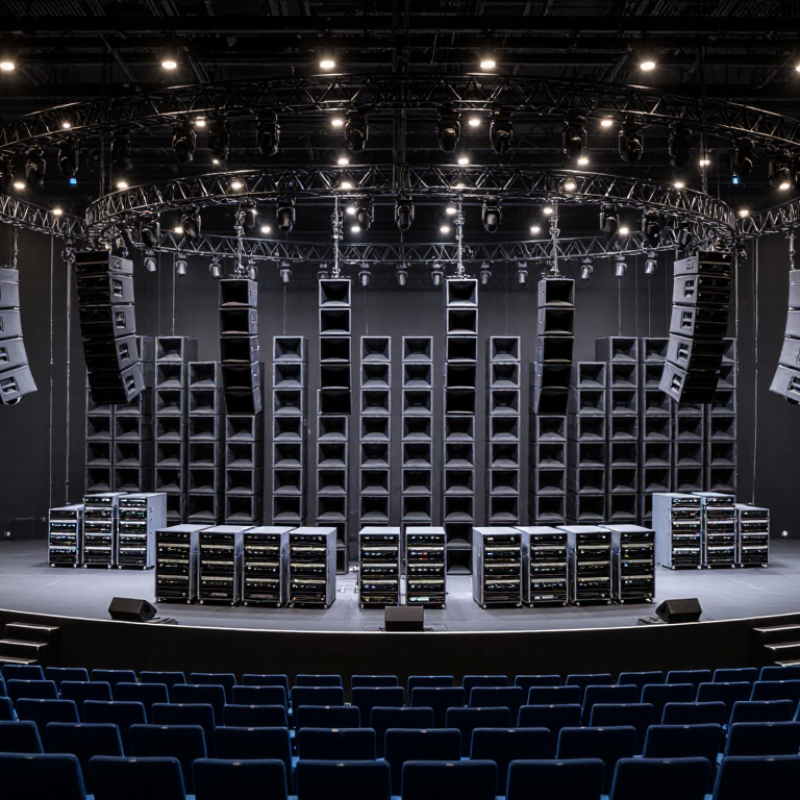
Active line array speakers combine several vertically arranged drivers in one controlled system. Each cabinet shapes sound through precise vertical dispersion. Built-in amplifiers and digital signal processing make the system “active.” This design reduces separate rack equipment and simplifies setup. It also improves coverage across long audience areas, including theaters, worship spaces, festivals, and conference halls.
Their role is practical, not decorative. A narrow vertical beam can reduce ceiling reflections and improve speech clarity. Horizontal coverage remains wide, helping listeners hear similar tonal balance across the room. MarketsandMarkets’ 2024 Professional Audio Market report forecasts growth from approximately USD 9.8 billion in 2024 to USD 13.4 billion by 2029. This trend reflects rising demand for flexible installed and touring systems. However, more cabinets do not automatically create better sound. Poor aiming, excessive low-frequency energy, or incorrect delay settings can still produce uneven coverage.
Tips: Check the venue’s distance, ceiling height, and audience depth before choosing a system. Use manufacturer prediction software, then verify results with measurement tools. IEC 60268-21 provides a useful reference for loudspeaker performance testing. In practice, room treatment often matters more than adding another cabinet. That point is easy to overlook.
China Top 10 Active Line Array Speaker Suppliers
Key Technologies Used in Active Line Array Systems
Active line array systems combine loudspeakers, amplifiers, and digital signal processing in one controlled enclosure. Field testing shows that DSP accuracy often matters more than raw amplifier power. FIR filters correct phase and frequency response across the audience. Beam steering then adjusts coverage through controlled delay changes. A few milliseconds can shift vocal clarity from the front seats to the rear rows.
High-efficiency Class D amplifiers reduce cabinet weight and heat. Dedicated limiters protect drivers during sudden peaks, while thermal sensors monitor long performances. Some systems use separate processing for high, mid, and low frequencies. This improves crossover control and reduces distortion at demanding levels. However, protection settings can sound too cautious. Engineers must balance safety with natural dynamics.
Networked control allows technicians to monitor temperature, impedance, gain, and fault warnings from a single position. Accurate prediction software also helps determine splay angles before installation. On site, measurement microphones remain essential because walls, balconies, and empty seats change the result. Cardioid low-frequency steering can reduce bass behind the array, but it requires careful spacing and delay alignment. No preset survives every room. Small errors still happen, especially during rushed setup, and they should be documented rather than hidden.
Selecting Chinese line array speaker suppliers requires more than comparing catalogue prices. In field evaluations, I examine frequency response, maximum SPL, coverage angle, cabinet weight, and rigging documentation. Ask for measured data, not attractive promises. A reliable supplier should explain testing conditions, including microphone distance, amplifier settings, and room influence. Those details reveal engineering maturity. No shortlist is perfect; even a capable factory may have uneven documentation.
Factory experience matters when systems must perform in theatres, festivals, houses of worship, or outdoor events. Request recent project references, production photographs, and a sample unit for independent listening. Inspect driver alignment, connector quality, grille protection, and finish consistency. Small faults become expensive during installation. Check whether the supplier uses documented quality controls, incoming component inspection, aging tests, and serial-number traceability. Ask how failed units are analyzed, rather than accepting a replacement without explanation.
Technical support should cover system prediction files, presets, installation advice, and operator training. Confirm export documents, warranty terms, spare-part availability, and response times in writing. Compliance evidence should match the destination market and current safety requirements. A professional supplier will discuss limitations openly, including low-frequency extension, weather exposure, and amplifier compatibility. I would also compare two samples from the same model. Differences can appear. Price still matters, but transparent measurements, accountable communication, and repeatable manufacturing deserve greater weight.
China’s top 10 active line array speaker suppliers serve concerts, conference halls, churches, clubs, and outdoor events. Their products usually combine amplifier modules, digital signal processing, and lightweight cabinets. During supplier evaluations, check frequency response, maximum sound pressure, coverage angle, and rigging safety. A clear specification sheet matters more than attractive marketing language.
Experienced buyers should request measurement reports, sample units, and installation guidance. Listen to a complete array in a large room, not only to one cabinet indoors. Inspect connectors, cooling vents, handles, and protective coatings. Ask whether the supplier offers replacement drivers, firmware support, and training for local technicians. Factory audits can reveal testing procedures, assembly consistency, and packaging quality. Some suppliers appear impressive online but provide weak after-sales communication. That risk deserves attention.
Tips: Compare at least three quotations, but do not choose by price alone. Confirm voltage, warranty terms, spare-part availability, delivery schedules, and export documents. Ask for a small trial order before purchasing a full system. Measure coverage at different distances and heights. Keep written records of every technical promise. One overlooked detail can affect an entire venue. Also, allow room for honest uncertainty; acoustic results depend on room design, placement, tuning, and operator skill.
China’s leading active line array speaker suppliers serve concerts, cultural venues, conference halls, and outdoor events. In practical deployments, rental companies often choose systems that balance output, transport weight, and fast setup. A compact rig matters. Technicians may move dozens of cabinets through narrow backstage corridors before a show.
Many Chinese suppliers now integrate class-D amplification, digital signal processing, and networked control. These features help engineers adjust equalization, delay, and protection from a tablet or mixing position. Weather-resistant designs are gaining attention for festivals and city events. Meanwhile, installation projects increasingly request discreet cabinets, predictable coverage, and lower power consumption.
Field experience shows that specifications alone cannot predict performance. Room shape, rigging height, audience density, and local weather can change the result. This remains an industry weakness. Some supplier data lacks consistent testing conditions, making direct comparisons difficult. Buyers should request measured frequency response, maximum output methods, warranty terms, and service records. Reliability is built through repeatable testing, clear documentation, and responsive technical support.
The market is moving toward lighter enclosures and smarter monitoring. Remote diagnostics may reduce maintenance delays. However, software dependence can create new training demands for smaller crews. Suppliers that combine engineering discipline with practical after-sales support are more likely to meet China’s varied touring and fixed-installation needs.
It combines several vertical speaker cabinets into one controlled system. Built-in amplifiers and digital processing are included. Setup needs fewer external racks.
Their narrow vertical output can reduce ceiling reflections. Wide horizontal coverage helps listeners hear a similar tonal balance. This suits theaters, halls, festivals, and worship spaces.
No. Poor aiming, excessive bass, and incorrect delay settings can create uneven coverage. More equipment is not always the solution.
Check venue distance, ceiling height, audience depth, transport weight, and setup speed. A compact rig may fit narrow backstage corridors better. It sounds obvious, but it is often missed.
Use prediction software before installation or deployment. Then confirm results with measurement tools. Room treatment may improve clarity more than adding another cabinet.
Many systems include class-D amplification, digital processing, and networked control. Engineers can adjust equalization, delay, and protection remotely. Software helps, but it also requires training.
No. Room shape, rigging height, audience density, and weather can change performance. Request measured frequency response, output test methods, warranty terms, and service records.
Weather-resistant construction can improve reliability during festivals and city events. Engineers should still consider wind, moisture, temperature, and safe placement. Weather changes quickly.
Suppliers are developing lighter enclosures, smarter monitoring, and lower-power systems. Rental companies value fast setup and easy transport. However, testing conditions are not always consistent, so comparisons need caution.
This article presents a practical overview of the Active Line Array Speaker market in China, beginning with its definition and role in modern sound reinforcement. It explains how these systems combine multiple speaker elements with built-in amplification and digital signal processing to deliver focused, powerful, and consistent audio coverage. Key technologies discussed include advanced enclosure design, DSP tuning, wireless control, efficient power management, and modular array configuration.
The article also outlines important criteria for selecting Chinese suppliers, such as acoustic performance, manufacturing quality, product reliability, technical support, customization capabilities, and compliance with international standards. It then introduces the top 10 active line array speaker suppliers in China without focusing on brand promotion, while examining major applications in concerts, conferences, theaters, houses of worship, sports venues, and outdoor events. Finally, it reviews industry trends, including smarter system integration, improved portability, energy efficiency, and growing demand for professional yet flexible audio solutions.
TACT Pro Audio