China has become a major sourcing center for professional loudspeaker systems. For global buyers, the real question is not simply whether China offers lower prices. It is whether a Professional Line Array delivers consistent coverage, reliable power handling, and dependable after-sales support.
AVIXA’s 2024 Industry Outlook and Trends Analysis valued the global professional AV market at approximately US$332 billion in 2024. This growth reflects stronger demand for systems used in concerts, houses of worship, conferences, sports venues, and outdoor events. Line array technology remains important because its vertically coupled cabinets can control sound directivity and reduce uneven coverage across large audiences. However, performance depends on cabinet design, waveguide accuracy, amplifier matching, rigging safety, and system tuning.
Independent testing still matters. The AES2 loudspeaker measurement standard encourages comparable data for power handling and performance evaluation. Buyers should also examine manufacturer frequency-response graphs, maximum SPL figures, dispersion angles, DSP presets, warranty terms, and replacement-part availability. A specification sheet may look impressive. Real results can differ in a reflective hall, a windy festival field, or a crowded venue.
Some Chinese manufacturers provide strong engineering, rapid customization, and competitive export experience. Others rely too heavily on copied designs or optimistic specifications. That difference deserves careful investigation. Factory audits, listening tests, reference installations, and sample orders can reveal more than a sales presentation. Reports provide useful market direction, but they cannot replace field experience. This article examines how global buyers can identify China’s best Professional Line Array solutions with technical discipline, commercial caution, and realistic expectations.
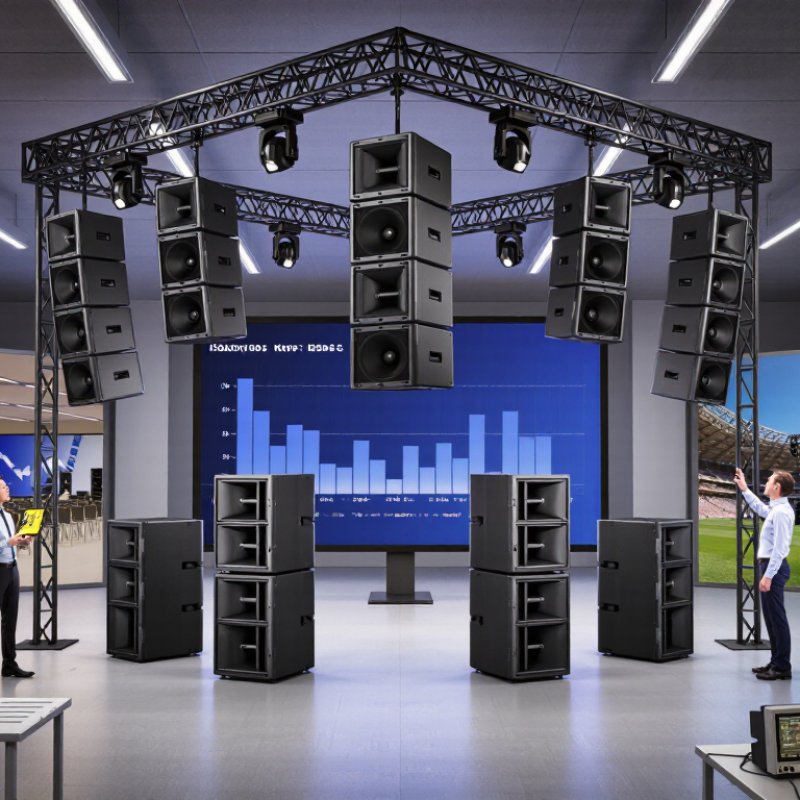
What Defines a Professional Line Array: SPL, Sensitivity, and 80–20,000 Hz Response
For global buyers, a professional line array is not defined by appearance alone. SPL, sensitivity, and frequency response reveal how it behaves under pressure. Maximum SPL indicates output before distortion becomes unacceptable. Ask whether the figure is peak or continuous. Those numbers are not interchangeable. A credible supplier should provide test conditions, measurement distance, and harmonic distortion data. Without that context, a large number may sound impressive but prove little in a venue.
Sensitivity shows how efficiently each watt becomes acoustic output. Higher sensitivity can reduce amplifier demand and improve headroom. Yet sensitivity varies across frequencies. Check the data around the vocal range, not only one attractive rating. An 80–20,000 Hz response suggests broad coverage, from firm low-mid body to intelligible high frequencies. However, the tolerance matters. A response of ±3 dB differs greatly from ±10 dB. Listen for harshness near 10 kHz and weak presence around 2 kHz. Small details affect speech, music, and listener fatigue.
In field testing, I would combine technical data with outdoor listening and near-field measurements. Stack height, splay angle, subwoofer alignment, and weather can change the result. Use pink noise and familiar speech. Keep notes. A system reaching 20 kHz may still sound dull if its dispersion is uneven. I also question the phrase “best.” The right array must suit the venue, audience distance, amplifier capacity, and service conditions. Specifications guide the purchase, but disciplined verification builds confidence.
What Defines a Professional Line Array?
SPL, sensitivity, and an 80–20,000 Hz frequency response are key specification points for evaluating professional line-array systems.
Peak SPL
135 dB
A high maximum sound-pressure level supports large venues and long-throw applications.
Sensitivity
105 dB SPL
Sensitivity indicates acoustic output efficiency measured at a defined input and distance.
Frequency Response
80–20,000 Hz
A broad response range helps reproduce vocals, instruments, and high-frequency detail.
The curve represents a brand-neutral professional design target, referenced to 0 dB at 1 kHz. Actual results depend on cabinet configuration, amplifier processing, measurement conditions, and array size. Peak SPL, sensitivity, and frequency response should always be compared using the same test standards.
How Line Arrays Work: Coupling, Directivity, and 3 dB Distance Loss
China Best Professional Line Array for Global Buyers?
How Line Arrays Work: Coupling, Directivity, and 3 dB Distance Loss
A line array uses closely spaced loudspeakers to control how sound travels. When the spacing is smaller than the wavelength, adjacent cabinets couple acoustically. Their energy combines more effectively on the vertical axis. This can produce a longer, more focused sound field.
Spacing matters greatly. High frequencies have short wavelengths, so they couple less easily between separate drivers. Low frequencies usually combine more naturally. Cabinet angles also shape directivity. Small splay angles create a narrow vertical beam, while larger angles spread sound between audience areas. It is a careful compromise.
The often-mentioned 3 dB distance loss needs context. In a useful cylindrical radiation zone, doubling distance may reduce level by about 3 dB. A conventional point source typically loses about 6 dB. However, no real array maintains perfect coupling at every frequency or distance. The far field eventually behaves more like a point source.
Measure it in the venue.
During system checks, I would compare front, middle, and rear audience positions. Prediction software helps, but walls, balconies, temperature, and humidity can change the result. I have seen a technically correct design sound uneven after deployment. That is not unusual. Recheck the angles, delay timing, and coverage before increasing output. More power cannot repair poor directivity.
How to Compare Chinese Systems: 10–20° Splay Angles and 90–120° Coverage
China’s Best Professional Line Array for Global Buyers?
How to Compare Chinese Systems: 10–20° Splay Angles and 90–120° Coverage
A professional line array should match the venue, not just the specification sheet. Splay angles from 10° to 20° control vertical dispersion between cabinets. Smaller angles usually create longer throw and tighter energy. Larger angles help cover balconies, near-field seats, or uneven audience areas. Horizontal coverage between 90° and 120° also matters. A wider pattern may reduce cabinet count, but it can increase side-wall reflections.
Tips: Ask for verified polar plots, frequency-response data, and maximum output at useful distances. Request measurements at one, ten, and thirty meters. Then compare the same frequency range and test conditions. Never judge coverage from a single peak SPL figure.
During system evaluations, I mark audience zones on a venue drawing. I check whether the front row receives too much energy. I also compare coverage at 1 kHz and 8 kHz, because high frequencies often narrow sooner. My early comparisons focused too much on the advertised angle. That was a mistake. Cabinet spacing, horn design, processing, and rigging height changed the real result. A 15° setting may work well in one hall but fail in a deep outdoor field. Reliable buyers should request a prediction file, inspect test records, and arrange an independent listening check before ordering.
Global Compliance Checklist: IEC 60268-5, EN 54-16, CE, and RoHS
Global buyers should treat compliance as a design check, not a sales label. AVIXA’s 2024 Industry Outlook valued the professional audiovisual market at about US$332 billion, increasing pressure for documented, export-ready equipment. IEC 60268-5 helps verify loudspeaker performance, including frequency response, sensitivity, impedance, and power handling. Ask for test conditions, measurement distances, and calibration records. “High power” means little without repeatable data.
EN 54-16 applies mainly to voice alarm control and indicating equipment, not automatically to every line-array loudspeaker. For loudspeakers used in voice evacuation systems, EN 54-24 may also be relevant. Check the complete system architecture. CE marking requires conformity with applicable European legislation, supported by a technical file and Declaration of Conformity. RoHS evidence should confirm restricted-substance controls throughout the supply chain. Do not accept a generic certificate.
In practice, inspect serial-number traceability, wiring diagrams, test reports, and production records. A factory audit can reveal loose terminals, uneven cabinet sealing, or unverified component substitutions. These details matter in a crowded venue. Compliance files can still contain gaps. That is worth admitting. Independent laboratory verification is stronger than a polished brochure, especially when importing into multiple jurisdictions.
Buyer Scorecard: Max SPL, 8–16 Ω Loads, Rigging Safety, and Total Cost
China Best Professional Line Array for Global Buyers?
A serious buyer scorecard starts with measurable output, not impressive brochures. Check maximum SPL at a stated distance, frequency range, and distortion limit. “Peak” figures can hide short test bursts. Continuous output matters more during a three-hour outdoor event. Listen at the rear seats. If vocals lose clarity, the number is not enough.
Impedance deserves equal attention. Confirm whether each cabinet presents 8 Ω or 16 Ω, and record the minimum load. Then match amplifier channels, cable lengths, and protection settings. A small mismatch can reduce headroom or trigger protection early. Keep test notes. They expose assumptions. My own first comparisons overvalued loudness and underweighted amplifier efficiency.
Rigging safety must be documented, not guessed from thick steel. Request working-load limits, inspection records, locking-pin details, and clear assembly instructions. A qualified technician should verify the array angle and suspension points for every venue. Local requirements still apply. Total cost includes transport cases, spare hardware, processing, amplification, labor, maintenance, and training. A lower purchase price may become expensive after repeated setup delays. Ask for replacement-part availability and realistic service times. Some scorecards also miss weather exposure; moisture, dust, and heat can change long-term reliability. That gap deserves a second review.
Conclusion
A Professional Line Array is defined by more than high volume. Global buyers should evaluate maximum SPL, sensitivity, and a consistent 80–20,000 Hz frequency response to ensure clear, powerful sound across different venues. Its performance comes from acoustic coupling between multiple elements, controlled directivity, and reduced distance loss—approximately 3 dB for each doubling of distance under suitable conditions. When comparing systems from China, buyers should examine practical 10–20° splay angles and 90–120° horizontal coverage to match the system with the venue and audience area.
A reliable purchasing decision should also include a global compliance checklist covering IEC 60268-5, EN 54-16 where applicable, CE, and RoHS documentation. The final scorecard should compare maximum SPL, sensitivity, 8–16 Ω load options, rigging safety, system consistency, service support, and total cost of ownership. This balanced approach helps buyers select a professional, scalable, and regulation-conscious line array system rather than judging performance by specifications alone.

 TACT Pro Audio