China has become an important manufacturing base for professional audio equipment, including the Passive Line Array System. Its suppliers serve touring companies, theaters, houses of worship, conference venues, and outdoor festivals. Production advantages include component access, engineering teams, flexible customization, and mature export logistics. Yet, factory scale alone does not guarantee dependable sound.
Industry data supports this growing market. Grand View Research identifies professional loudspeakers as a continuing growth segment, driven by live events, installed audio, and commercial entertainment. MarketsandMarkets also reports rising demand for networked and high-performance audio systems across professional applications. These reports indicate opportunity, but they do not replace technical evaluation. Frequency response charts can look impressive. Real venues are less forgiving.
As sound-system designer Bob McCarthy has stated, “A line array is not a magic wand.” That warning matters when comparing Chinese manufacturers. A reliable Passive Line Array System requires controlled vertical dispersion, consistent phase behavior, efficient rigging, and verified coverage predictions. Buyers should examine polar measurements, amplifier compatibility, enclosure materials, warranty terms, and field-service capability. Ask for independent test results.
In practice, a well-designed system should deliver clear vocals at the rear of a 1,500-seat hall, not only powerful bass near the stage. It should also maintain intelligibility under changing temperature and audience conditions. Some manufacturers explain these limits clearly. Others focus too heavily on specifications. This is where careful judgment becomes essential.
The best Chinese manufacturers combine repeatable production with acoustic expertise, documented testing, and responsive support. Their value should be measured in predictable performance, not simply lower pricing. There is still room for improvement, especially in transparent data and long-term service. That imperfection deserves attention.
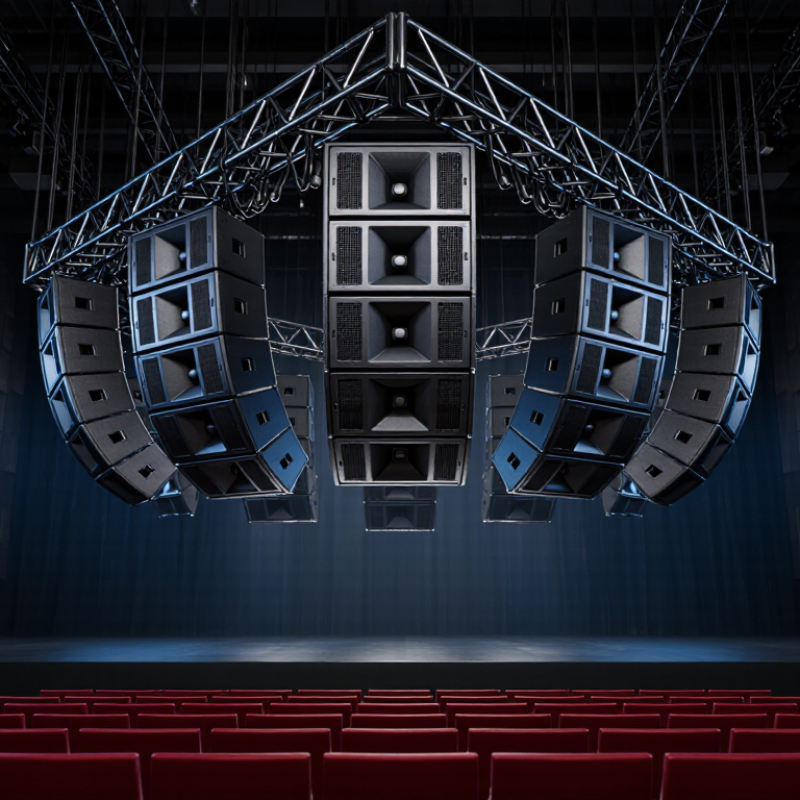
A passive line array system combines multiple loudspeaker cabinets into a vertical array. Each cabinet contains drivers, a crossover network, and passive wiring. An external amplifier supplies the required power. This design helps control sound direction across large venues, including theaters, conference halls, and outdoor events.
Its structure is more precise than a simple speaker stack. Compact cabinets use carefully shaped waveguides to align high-frequency output. Low and mid-frequency drivers support vocal clarity and musical weight. Rigging frames connect the cabinets at fixed angles. Small angle changes can strongly affect coverage. That detail is easy to underestimate.
Core features include long-distance projection, smoother vertical dispersion, and flexible system expansion. Passive systems also reduce the number of powered components near the loudspeakers. However, they require correct amplifier matching, cable selection, and processor settings. Excessive power can damage drivers. Too little power may create audible distortion.
For buyers evaluating manufacturers in China, quality control deserves close attention. Check enclosure strength, connector reliability, crossover protection, and test documentation. Ask for polar plots and frequency-response data, not only attractive specifications. Field results may differ from laboratory measurements. A useful system should sound even at the rear seats, not merely loud near the stage. Some installation plans still need adjustment after the first listening test. That is normal, and it should be documented rather than hidden.
| Dimension | Technical Definition or Typical Data | Structural Elements | Core Benefit or Application Value |
|---|---|---|---|
| Definition | A passive line array system is a group of vertically coupled loudspeaker elements designed to control sound directivity and provide consistent coverage over distance. | Multiple line-array enclosures, passive crossover networks, rigging hardware, speaker cables, and external power amplifiers. | Suitable for concerts, theaters, houses of worship, conference venues, outdoor events, and other spaces requiring controlled sound distribution. |
| Typical Frequency Configuration | Two-way systems commonly combine low/mid-frequency drivers with high-frequency compression drivers. Exact frequency ranges depend on enclosure design and manufacturer specifications. | Low/mid-frequency transducers, high-frequency driver, horn or waveguide, passive crossover, and protective grille. | Provides full-range reproduction while keeping the enclosure compact and mechanically stackable. |
| Line-Array Coupling | Closely spaced elements can produce stronger vertical acoustic coupling, particularly when the spacing is small relative to the wavelength being reproduced. | Slim cabinets, closely positioned acoustic centers, and adjustable inter-box angles. | Improves control of vertical dispersion and helps reduce unnecessary sound energy directed toward ceilings and floors. |
| Horizontal Dispersion | Common horizontal coverage angles include approximately 80°, 90°, or 100°, although the actual value varies by waveguide and enclosure design. | High-frequency waveguide, horn geometry, and cabinet baffle shape. | Allows system designers to match the coverage pattern to the width and geometry of the audience area. |
| Vertical Dispersion | Vertical coverage is determined by the number of elements, enclosure angle, and array curvature. Larger arrays generally provide narrower and more controlled vertical coverage. | Rigging frame, angle-adjustment mechanism, cabinet spacing, and array curvature. | Supports even audience coverage from near-field areas to longer throw distances when correctly designed and aimed. |
| Passive Crossover Network | The crossover divides the incoming full-range signal between low/mid-frequency and high-frequency drivers. Crossover frequency and filter slope are system-specific. | Inductors, capacitors, resistors, protection components, and signal-routing circuitry. | Simplifies system wiring by allowing one amplifier channel to feed a complete passive enclosure, subject to its power and impedance limits. |
| Nominal Impedance | Common nominal values are 4 Ω or 8 Ω per enclosure. The minimum impedance can be lower than the nominal rating and must be checked before amplifier selection. | Driver voice coils and passive crossover network connected to the input terminals. | Determines amplifier load, maximum cabinet quantity per channel, cable current, and safe system operation. |
| Power Handling | Power ratings may be specified as continuous, program, or peak values. Continuous and program ratings are more useful for system planning than peak figures alone. | LF/MF drivers, HF driver, crossover components, thermal protection, and enclosure ventilation. | Helps match the loudspeaker to an amplifier while reducing the risk of thermal or mechanical damage. |
| Sensitivity and Maximum SPL | Sensitivity is commonly measured in dB at 1 W and 1 m. Maximum SPL depends on sensitivity, power handling, compression, limiter settings, array size, and measurement method. | Drivers, acoustic loading, cabinet alignment, crossover, and amplifier output. | Provides a basis for estimating output capability, though manufacturer measurement conditions must be compared carefully. |
| Frequency Response | Published response is normally shown with a tolerance such as ±3 dB or a broader limit such as −10 dB. The usable low-frequency extension changes with enclosure size and system configuration. | Driver selection, enclosure volume, ports, waveguide, and passive crossover tuning. | Indicates tonal bandwidth and whether additional subwoofers are required for low-frequency program material. |
| Rigging and Mechanical Structure | Line-array elements use rated rigging points and adjustable inter-box angles. Suspension must follow the system's load limits and approved hardware requirements. | Fly frame, rigging pins, side plates, locking mechanisms, enclosure hardware, and safety attachments. | Enables flown, ground-stacked, or hybrid configurations when installed by qualified personnel under appropriate safety procedures. |
| Cabinet Construction | Professional enclosures are commonly built from plywood or other engineered materials, with protective coatings and reinforced mounting points. | Wood or composite cabinet, internal bracing, grille, coating, handles, and connector panels. | Balances acoustic rigidity, durability, portability, and resistance to repeated touring or installation use. |
| Input and Output Connections | Professional passive systems commonly use locking speakON-type connectors or equivalent high-current loudspeaker connectors; connector type is model-specific. | Input/output terminals, internal wiring, connector plate, and polarity markings. | Supports secure signal transmission and convenient daisy-chaining where impedance and amplifier limits permit. |
| External Amplification | The amplifier must be compatible with the loudspeaker's impedance, continuous power requirement, limiter strategy, and desired headroom. | Power amplifier, speaker-management processor, protection limiter, cabling, and distribution hardware. | Provides scalable system power and allows installers to optimize crossover, equalization, delay, and protection settings. |
| Subwoofer Integration | Passive line array elements are often used with separate subwoofers because compact line-array cabinets generally do not reproduce very low frequencies at high output levels. | Subwoofer cabinets, low-pass filtering, high-pass filtering for the line array, and time-alignment controls. | Extends low-frequency response and increases overall headroom for music, cinema, and live-event applications. |
| Main Advantages and Limitations | Advantages include controlled vertical coverage, scalable output, efficient long-distance projection, and straightforward passive signal routing. Limitations include the need for accurate aiming, safe rigging, suitable amplification, and careful array-size selection. | Complete system performance depends on enclosure count, splay angles, processor settings, amplifier capability, room acoustics, and installation height. | Delivers predictable coverage when properly designed, measured, installed, and operated within published technical limits. |
Note: Technical values such as impedance, power handling, frequency response, dispersion, and maximum SPL vary by model and measurement method. Always verify the relevant product specifications and installation requirements before system design or deployment.
Compare engineering experience, production history, acoustic data, and communication quality. Ask for frequency response, sensitivity, maximum SPL, impedance, and coverage angles. A low price proves little.
Laboratory samples may not represent mass-produced cabinets. Request reports from recent batches, including distortion and frequency measurements. This reveals consistency. Still, reports need independent checking.
Inspect cabinet assembly, internal wiring, connectors, aging tests, and packaging. Look for moisture-resistant plywood and strong internal bracing. Check whether spare parts remain available after delivery.
Audition several units in a room resembling your venue. Listen for clear vocals, stable coverage, and harsh high frequencies. Outdoor testing can reveal weak weather protection. One listening session is not enough.
Request cabinet drawings, rigging instructions, load-test records, and stated safety factors. The drawings should match the delivered system. Verify corrosion protection on metal hardware. Details can prevent expensive mistakes.
Look for incoming component inspection, serial tracking, polarity checks, and final acoustic testing. Connector durability and insulation should also be tested. Documented procedures support repeatable results. No factory is flawless.
Driver sensitivity and crossover components can vary slightly between batches. Compare frequency response, impedance, output, and physical construction. A strong sample does not guarantee consistent production. This is easy to overlook.
The crossover should maintain smooth phase behavior and stable impedance. The waveguide should support even vertical coverage across listening angles. Small design errors may produce harsh vocals or uneven sound. Technical explanations matter more than polished presentations.
Confirm warranty terms, installation guidance, spare-part availability, and response procedures. Ask for independently verifiable project references. Written answers are safer than informal promises. Some uncertainty will remain.
This article provides a practical overview of the Passive Line Array System, explaining its definition, structural components, operating principles, and core advantages such as focused sound projection, consistent coverage, scalability, and efficient deployment. It also examines China’s growing manufacturing industry and market landscape, highlighting the importance of engineering capability, production consistency, research investment, and after-sales support when evaluating potential suppliers.
The discussion further introduces key technologies and quality standards related to loudspeaker drivers, cabinet design, waveguides, crossover networks, power handling, acoustic testing, and system reliability. It also considers common applications in theaters, conference venues, worship spaces, outdoor events, and large public facilities. Finally, the article outlines customization options and practical manufacturer selection criteria, including technical communication, project experience, testing procedures, delivery capacity, documentation, warranty policies, and long-term service, helping buyers make informed decisions based on performance, compatibility, budget, and application requirements.

 TACT Pro Audio