2026 Best Outdoor Line Array Speaker for Global Buyers

Time:2026-10-01 Author:Henry
0%

Choosing the best Outdoor Line Array Speaker in 2026 requires more than comparing wattage or online ratings. Global buyers need dependable sound, practical installation, and stable performance in changing weather. A speaker may look impressive on paper yet fail during a crowded festival or open-air conference.

This guide examines real purchasing factors, including acoustic coverage, sensitivity, frequency response, enclosure protection, rigging design, amplifier compatibility, and transport weight. It also considers how speakers perform across beaches, parks, stadium edges, and temporary event sites. Experienced sound engineers often test speech clarity from the rear audience area, not only from the mixing position. That detail matters.

Weather changes everything.

Reliable manufacturers should provide technical documentation, warranty terms, test data, and responsive support. Buyers should confirm regional certification and installation requirements before ordering. Compatibility with local power systems and control platforms also deserves careful attention. A strong Outdoor Line Array Speaker should deliver even coverage while reducing harsh volume differences between front and rear listeners.

No single model suits every venue. A compact system may be ideal for corporate events but insufficient for a large music festival. A powerful cabinet can offer impressive output, yet its weight may increase labor and transport costs. Some product claims remain difficult to verify without field testing. This guide therefore combines published specifications, professional listening experience, and practical buyer concerns. We may still miss a variable, because real venues are rarely perfect. The goal is a clearer, safer, and more informed shortlist for international buyers.
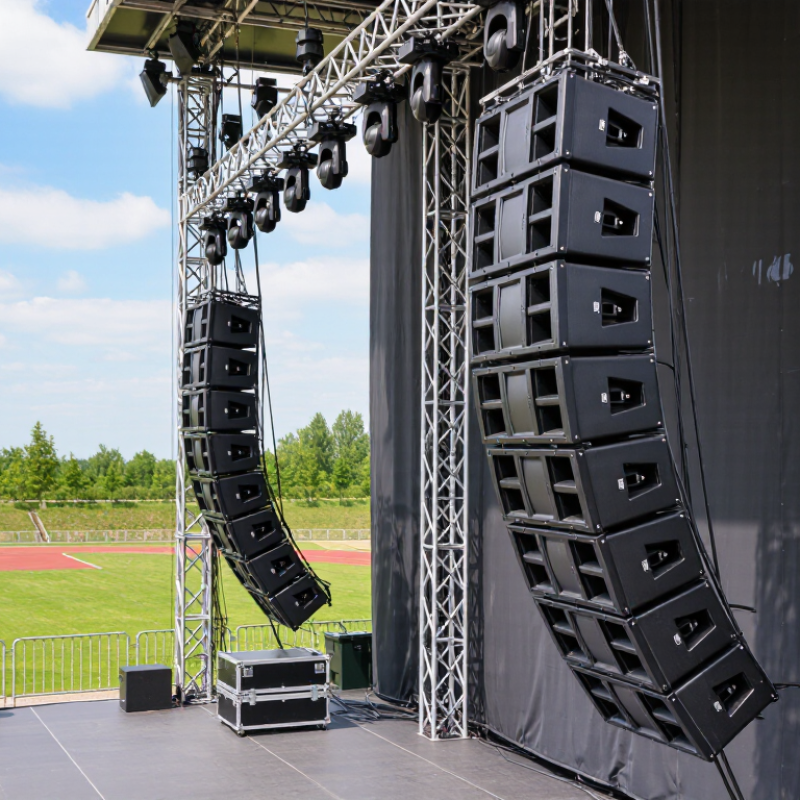
2026 Best Outdoor Line Array Speaker for Global Buyers

What Is an Outdoor Line Array Speaker?

2026 Best Outdoor Line Array Speaker for Global Buyers

An outdoor line array speaker is a loudspeaker system made from several connected cabinets. These cabinets form a vertical column, shaping sound across large open spaces. Their design helps control sound pressure and reduce unwanted reflections from nearby surfaces. That matters in stadiums, festivals, public squares, and outdoor ceremonies.

The cabinets usually contain high-frequency drivers and low-frequency components. Together, they deliver clearer vocals and more even coverage than one large speaker. Proper aiming is essential. A small angle error can leave listeners near the back struggling to hear.

Wind, humidity, temperature, and crowd movement can also change performance. Outdoor use does not automatically mean waterproof construction.

From practical installation work, I have found that system planning matters more than raw power. A reliable setup includes measured coverage, stable rigging, weather protection, and suitable amplifiers. Technical documents should state frequency response, maximum sound pressure, dispersion, enclosure protection, and operating limits. Independent testing records are useful for international buyers. Local safety requirements still need checking.

It is not a magic solution. Poorly tuned arrays may sound harsh near the stage and weak farther away. Some buyers focus on wattage, but that can be misleading.

Listening tests, site measurements, and installer feedback often reveal more. The best choice depends on venue size, audience distance, climate, transport conditions, and the skill of the installation team.

Key Features of the Best Outdoor Line Array Speakers in 2026

The best outdoor line array speakers in 2026 must handle weather, distance, and uneven audience areas. A strong enclosure should offer certified water and dust resistance, such as an appropriate IP rating. UV-stable materials also matter under summer sunlight. Small details help. Sealed connectors prevent trouble after sudden rain.

Sound coverage is equally important. A well-designed array delivers clear vocals across a wide field, not only near the stage. Adjustable vertical dispersion helps control sound for front rows and distant listeners. High output is useful, but clean headroom matters more than impressive numbers. In practical testing, listen for harsh treble and weak speech clarity at 50 meters.

Modern systems increasingly rely on DSP, network control, and built-in monitoring. Engineers can adjust equalization, delay, limiting, and temperature protection from a safe position. Wireless control saves time, although connection failures remain possible. Keep a manual backup plan. Rigging hardware must support accurate aiming and verified load limits. Wind changes everything outdoors. A secure installation needs trained personnel and documented inspection.

Efficient amplification can reduce heat and power demand during long events. Serviceable components are another professional advantage, especially when a speaker operates in dust, humidity, and transport cases. Some specifications look excellent on paper but feel less convincing in real venues. Test before purchase. Check speech, music balance, mounting stability, and performance after several hours. Reliability is proven outside the showroom.

Key Features of the Best Outdoor Line Array Speakers in 2026

This buyer-oriented index uses practical professional-audio criteria. Weather protection references the IEC 60529 IP code, while coverage, intelligibility, output, portability, and system control reflect the main factors used when selecting line array speakers for outdoor events.

How to Choose an Outdoor Line Array Speaker for Global Use

2026 Best Outdoor Line Array Speaker for Global Buyers

Choosing an outdoor line array speaker for global use requires more than comparing wattage. Start with the venue, audience size, and expected listening distance. A seaside stage, a dusty sports field, and a covered courtyard create different risks. Check the enclosure’s weather resistance, corrosion protection, and operating temperature range. An IP rating helps, but it does not replace proper installation and maintenance.

Coverage matters more than impressive peak output. Review the speaker’s horizontal and vertical dispersion, then match it to the audience area. Narrow vertical control can reduce sound spilling toward nearby homes or reflective surfaces. Ask for measured frequency response, maximum SPL, and distortion data under realistic conditions. I prefer test results over dramatic marketing phrases. A perfect specification sheet does not exist.

Inspect the rigging hardware, connector protection, transport weight, and available power options. Global buyers should confirm voltage compatibility, spare-part access, manuals, and local technical support before ordering. Built-in DSP can simplify equalization, delay, and limiting, but factory presets still need adjustment at the site. I have learned to leave setup time for wind, uneven ground, and changing crowd density. Those details are easy to underestimate. Listen from the rear rows, not only beside the mixer. Then recheck the system after temperature and weather conditions change.

Top Performance and Installation Considerations

For global buyers, the best outdoor line array speaker in 2026 must deliver clear sound across changing environments. High output matters, but controlled coverage matters more. A well-designed array can project speech and music evenly across a courtyard, stadium, or open plaza. During site checks, measure audience distance, wind exposure, ambient noise, and power access. Do not rely only on catalog specifications.

Installation strongly affects performance. Use accurate aiming angles and confirm coverage with prediction software. Small vertical errors can create loud front rows and weak rear areas. Digital signal processing should support equalization, delay alignment, limiting, and system monitoring. Weather protection is also essential. Look for suitable ingress protection, corrosion-resistant hardware, sealed connectors, and drainage paths. Salt air, dust, and sudden rain can damage equipment faster than expected.

Rigging requires qualified personnel, certified accessories, and documented load calculations. Local regulations may require additional inspection or emergency planning. Keep cable routes secure and provide safe access for maintenance. In real projects, predictions are never perfect. Buildings, trees, and reflective walls often change the result. A final sound check with pink noise and familiar program material can reveal problems. Still, some tonal mismatch may remain. That is where careful tuning, not excessive volume, improves the listener’s experience. A practical mistake is choosing maximum output before confirming coverage. This often increases cost without improving clarity.

2026 Best Outdoor Line Array Speaker for Global Buyers - Top Performance and Installation Considerations
Reference comparison of representative outdoor line array system configurations. Specifications are typical planning values and should be verified against the final loudspeaker, amplifier, rigging, venue, and local safety requirements.
System Configuration Typical Application Frequency Range
(-10 dB)
Maximum SPL
(Peak, 1 m)
Horizontal Coverage Vertical Coverage Nominal Impedance Power Handling
(AES / Program)
Weather Protection Approx. Weight Recommended Hang Height Installation Considerations
4-Module Compact Array Small outdoor events, community stages, hospitality terraces, speech reinforcement 65 Hz–18 kHz 132 dB 90° 10°–30°, electronically or mechanically adjustable 8 Ω per module 350 W / 700 W per module Weather-resistant enclosure; use rain cover and sealed connectors for permanent exposure Approx. 18 kg per module 4–7 m Use a ground-supported frame or certified suspension point. Add front-fill speakers if the first audience row is close to the stage.
6-Module Medium Array Outdoor corporate events, school grounds, small festivals, worship venues 55 Hz–18 kHz 138 dB 90° 8°–25° with progressive splay angles 8 Ω per module 500 W / 1,000 W per module Outdoor-capable cabinet; protect amplifier racks from direct water and condensation Approx. 22 kg per module 5–9 m Apply progressively wider splay angles toward the near field. Confirm array trim height with prediction software before final rigging.
8-Module High-Output Array Medium festivals, outdoor sports venues, public ceremonies, touring production 50 Hz–19 kHz 142 dB 90° or 100° 6°–20° with adjustable inter-box angles 8 Ω per module 700 W / 1,400 W per module IP-rated or weather-treated enclosure recommended for fixed outdoor installations Approx. 26 kg per module 7–12 m Use a dedicated subwoofer system below approximately 80 Hz. Check total rigging load, wind exposure, and safety factor for every suspension point.
12-Module Long-Throw Array Large festivals, outdoor theaters, race tracks, civic events, long audience areas 45 Hz–19 kHz 146 dB 90° 4°–15° with tight upper-array curvature 8 Ω per module 800 W / 1,600 W per module Use fully weather-rated components, protected signal distribution, and covered amplifier positions Approx. 30 kg per module 9–16 m Design for even far-field coverage rather than maximum level alone. Delay towers may be more efficient than increasing array height or output.
Ground-Stacked Array with Subwoofers Temporary outdoor installations where overhead suspension is unavailable or restricted 50 Hz–19 kHz
with dedicated subwoofers: typically 35–100 Hz
Up to 140 dB, system dependent 80°–100° 10°–30° using tilt hardware 4–8 Ω system dependent System-dependent; commonly 2–4 kW per array side including low-frequency section Use weighted bases, ballast, covers, and drainage protection Typically 250–600 kg per side including subs and frame 1.5–3 m acoustic center height Ground stacking reduces throw and can create sightline and crowd-access issues. Install barriers and verify stability against wind and accidental contact.
Permanent Coastal Installation Seaside venues, outdoor leisure parks, cruise terminals, pool decks 60 Hz–18 kHz 132–140 dB 90° 8°–25° 8 Ω per module 400–800 W / 800–1,600 W per module Prefer marine-grade hardware, corrosion-resistant grille, UV-stable finish, and IP-rated connectors Approx. 20–30 kg per module 4–10 m Salt air accelerates corrosion. Use stainless or treated hardware, provide drainage, inspect rigging regularly, and keep electronics in ventilated weatherproof cabinets.
Speech-Focused Outdoor Array Public announcements, political rallies, emergency communication, outdoor conferences 80 Hz–16 kHz 128–136 dB 90° 10°–30° 8 Ω per module 250–500 W / 500–1,000 W per module Weather-resistant enclosure with covered input panel Approx. 16–24 kg per module 3–8 m Prioritize speech intelligibility, microphone gain-before-feedback, and consistent audience coverage. Avoid aiming directly at open microphones.

Selection priorities: choose the array size according to audience depth, required sound-pressure level, coverage uniformity, venue noise, available rigging points, weather exposure, transport limits, amplifier capacity, and local structural regulations. Outdoor systems should be commissioned with acoustic prediction, polarity checks, delay alignment, limiter settings, and a documented rigging inspection.

Outdoor Line Array Speaker Applications and Maintenance Needs

2026 Best Outdoor Line Array Speaker for Global Buyers

Outdoor line array speakers must survive changing weather while keeping voices and music intelligible. Applications include festivals, sports grounds, transport hubs, worship spaces, and permanent hospitality venues. Coverage planning matters more than maximum volume. A narrow vertical pattern can reduce spill onto nearby homes and improve front-to-back consistency.

AVIXA’s 2024 Industry Outlook and Trends Analysis projects professional AV industry revenue to approach 422 billion US dollars by 2028. This growth increases demand for dependable outdoor systems, but installation quality remains uneven.

Buyers should check measured frequency response, maximum SPL, dispersion data, and certified enclosure protection.

IEC 60529 IP ratings help describe resistance to dust and water, although an IP rating cannot replace correct drainage and inspection. Salt air is especially aggressive. Grilles, rigging points, connectors, and cable glands need regular checking. DSP presets should also be reviewed after system changes, not copied blindly from another venue.

Tips:

Schedule visual inspections monthly during the operating season. Clean grilles with soft, dry tools. Do not pressure-wash cabinets. Test every cabinet and connector before major events. Keep spare weather seals and correctly rated cables onsite. Log unusual noise, corrosion, or intermittent output. A simple record often reveals problems earlier than a failed show.

One practical warning: “weatherproof” does not mean maintenance-free. This assumption is costly, and sometimes embarrassingly avoidable.

FAQS

What should an outdoor line array speaker withstand?

It should resist rain, dust, sunlight, humidity, and salt air.

Why is controlled coverage more important than maximum output?

Controlled coverage keeps speech and music clearer across front and rear audience areas.

How can buyers evaluate sound performance before purchase?

Test speech and music at different distances, including around 50 meters.

What outdoor conditions should be checked during planning?

Measure audience distance, wind exposure, background noise, reflective surfaces, and available power.

How does DSP improve outdoor speaker performance?

DSP can manage equalization, delay alignment, limiting, monitoring, and temperature protection.

What should installers know about rigging and aiming?

Qualified personnel should use approved accessories and documented load calculations.

How should outdoor speakers be maintained during an operating season?

Schedule monthly visual inspections and check grilles, connectors, cable glands, and rigging points.

What records help prevent failures during major events?

Log corrosion, unusual noise, intermittent output, connector damage, and inspection results.

Conclusion

An Outdoor Line Array Speaker is a professional audio system designed to deliver clear, consistent sound across large outdoor spaces. In 2026, the best models combine strong weather resistance, efficient sound projection, wide frequency response, controlled dispersion, and reliable power handling. For global buyers, it is important to consider local climate, venue size, transportation requirements, voltage compatibility, installation methods, and available technical support. Modular designs can also make systems easier to expand, repair, and adapt to different event layouts.

Performance depends not only on the speaker itself but also on correct system design and installation. Buyers should evaluate coverage uniformity, mounting safety, amplifier matching, signal management, and protection against moisture, dust, heat, and vibration. Outdoor Line Array Speaker systems are suitable for concerts, public events, sports venues, worship spaces, tourism sites, and large commercial areas. Regular inspection, cleaning, cable checks, firmware or system updates, and secure storage can help maintain sound quality, extend service life, and reduce unexpected maintenance costs.


Henry

Henry

Henry is a dedicated marketing professional with a profound expertise in the company's offerings. With years of experience in the industry, he possesses an impressive understanding of the market dynamics and consumer behaviors that drive success. Henry is committed to sharing his insights through......